
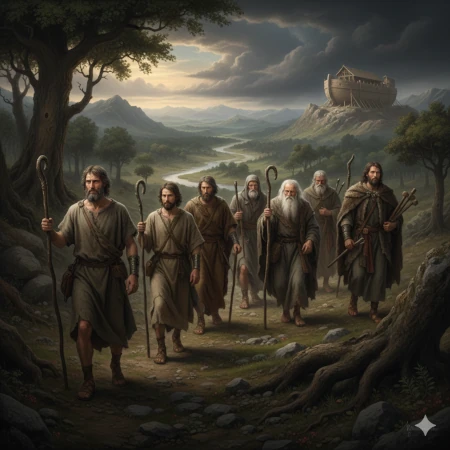
Today’s post is dedicated to the Sumerian descendants of Adapa and Titi, hybrids fathered by the god Enki and Earthly women.
Tablets 8 and 9 of the “Lost Book of Enki” provide a wealth of interesting information that could have been used in later “sacred” books.
Ka-in (Cain), Adapa’s (Abel) son, after murdering his brother Abael, was exiled to the “east,” to the “land of wanderings,” and Ningishzidda marked Ka-in by altering his “life essence” so that a beard and mustache would not grow on his face.
Enkime, according to the eighth clay tablet, was wise and intelligent, “quickly grasping the meaning of numbers.” Enki taught him about the planets of our solar system, counting the Shars on Nibiru and the years on Earth, the division of the 12 constellations, and so.
“Enkime desired to explore the heavens; he made two celestial journeys.
…From there, Marduk took him by rocket to the Moon.
When Enkime returned to Earth to be with Utu in Sippar, he was sent to the Place of the Chariots. There he received a tablet to record what he had learned from Utu.”
For his sons, Enkime wrote down what he had learned about the heavens, imparting to them knowledge of the four corners of the Earth, its lands, and its rivers.
Enkime was then taken to heaven a second time and remained there for the rest of his life.
Lu-Mach’s wife, Batanesh, was a woman of extraordinary beauty, and Enki took a liking to her. Enki ordered her brought to him, had intercourse with her, and Batanesh became pregnant by Enki and gave birth to a son.
After Lu-Mach returned home to the Edin, he learned that he had a son, whom he had not fathered; his father was the god Enki.
Moreover, the son’s appearance was different from that of humans:
“His skin was as white as snow, and his hair was the color of wool,
His eyes were like the sky, radiant.
May the son born to you be a harbinger of coming respite…
…Let his name be Comfort!”
All the themes mentioned in today’s post were used in other, later accounts, including the Judeo-Christian Bible (biblical/other equivalents in parentheses):
1. The exile of Ka-in (Cain) after killing his brother Abael (Abel) to the east and his “marking” by God
2. The next son of Adapa and Titi was named Sati (Set)
3. Enki-Me/Enkime (Enoch) was taken to heaven twice. After the first time, he wrote everything down and passed it on to his son Methuselah (Methuselah) https://anuchildren.org/was-enoch-taken-to-the-heaven-twice/
4. Methuselah’s son Lu-Makh (Lamech) married his wife Batanesh (Jewish: Nammah; Islamic: Waila)
5. Batanesh became pregnant by the god Enki and gave birth to A hybrid whose appearance differed from that of other humans; he was to become the new progenitor of the rebirth of human society after the flood, and whose name was Ziusudra (Jewish: Noah, meaning comfort, rest).
To summarize all of the above, I would just like to add that, in my opinion, and perhaps many others, the biblical descriptions were borrowed from older, Sumerian accounts.
We must ask ourselves: were the gods whom the Sumerians believed shaped the human species actually material beings of a higher degree of development who have been intervening in our development for centuries?
As always, I leave the interpretation to each individual.
Related posts:
 Did Gilgamesh and Enkidu defeat the machine in the cedar forest on the way to the Anunnaki rocket port?
 What happened to the first human couple on Earth after they were expelled from the Sumerian E.DIN?
 Was the Moon visited by extraterrestrials thousands years ago?
 Adapa – the first human which fly into space