
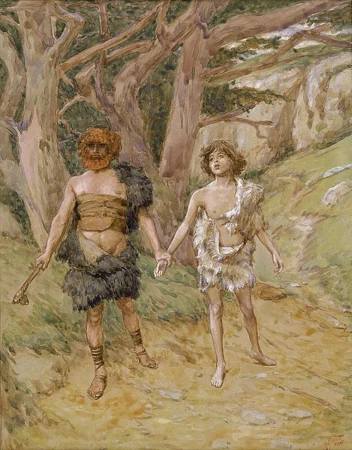
I want to dedicate today’s post entirely to Ka-in’s killing of Abael. This is the story of two brothers, sons of the first human pair, Adamu and Ti-amat, created on Earth by the Anunnaki. This entire story was written on the eighth clay tablet, known as part of the ‘Lost Book of Enki.’
In a few previous posts, I tried to find connections between Abael and Ka-in, and the Judeo-Christian Abel and Cain and searched for information about the fate of Cain and his descendants.
Today I will check what Lord Enki, son of Anu, the supreme ruler of Nibiru, has to say on this matter.
After Adapa’s return from Nibiru, Ninurta, son of Enlil, taught Ka-in how to “grow food in the field“, sowing, and harvesting, and also made him a wooden plow.
The name Ka-in meant “he who grows food in the field.”
Adapa’s second son, Abael, was taken by Marduk, son of Enki, and taught him how to build stables. After bringing back from Nibiru the “essence of sheep’s seed,” the breeding of these animals, which had never been seen on Earth before, began. This breeding was entrusted to Abael.
When the first harvest was reaped and the first sheep matured, a “Feast of Firstfruits” was celebrated.
At the feet of Enlil and Enki, Abael offered an animal sacrifice, and Ka-in offered a sacrifice of the crops of the land. Enki blessed Abael’s animal offerings but did not bless Ka-in’s agricultural offerings.
This led to Ka-in’s anger and a quarrel between the brothers, which resulted in Ka-in’s murder.
The Anunnaki organized a judgment on Ka-in and, after a joint decision, banished him “to the ends of the earth.”
Furthermore, Ka-in’s “life essence” was altered so that a beard would not grow on his face.
Cain left the Edin (ED.IN) with his sister Awan, whom he married.
This story aligns with the oral traditions of the Aztecs, who claimed that their ancestor who founded the city of Tenochtitlan was (T)Enoch, son of Cain.
It also partially aligns with two stories from the Book of Mormon, in which humans, guided by an angel, crossed the ocean and reached South America.
In conclusion, I will also add that according to Sumerian accounts, the first human couple, Adamu and Ti-amat, after the death of Abael, had many daughters for many years, but no son. When a son was finally born to them, they named him Sati (he who binds life again), and from him began the counting of the generations of Adapa. Regardless, the name Sati is very similar to the name of the third son of Adami and Eve, Seth, and the counting of generations follows the list of Adamam’s descendants.
The similarities between Sumerian and biblical accounts are significant and unmistakable, again opening the possibility of interpreting the Old Testament as based on the oldest known Sumerian accounts.
Is this really the case? I leave this question to each individual to consider.
Related posts:
 Did Gilgamesh and Enkidu defeat the machine in the cedar forest on the way to the Anunnaki rocket port?
 What happened to the first human couple on Earth after they were expelled from the Sumerian E.DIN?
 Was the Moon visited by extraterrestrials thousands years ago?
 Adapa – the first human which fly into space